К 100 летию со дня рождения американского писателя-фантаста Ч. А. Ллойда (1924–2007)
Американский детский писатель, один из ведущих авторов классического детского фэнтези, известный прежде всего циклом «Хроники Прайдена». Один из создателей и постоянных авторов детского журнала «Сверчок» (Cricket).
Александер любил кошек. О своих котах он написал две книги, одну из первых — «Пять моих тигров» (My Five Tigers), и одну из поздних — «Мои коты и я» (My Cats and Me). Говорящие коты, помогающие людям — частые герои его книг, в том числе первого фантастического романа «Временной кот» (Time Cat), детской повести «Цыганка Ризка» (Gypsy Rizka), исторической фэнтези «Яшмовый Сон» (Dream-of-Jade), всех сказок сборника «Городские коты» (The Town Cats).
Предлагаем отрывок из сборника «Городские коты» (The Town Cats).
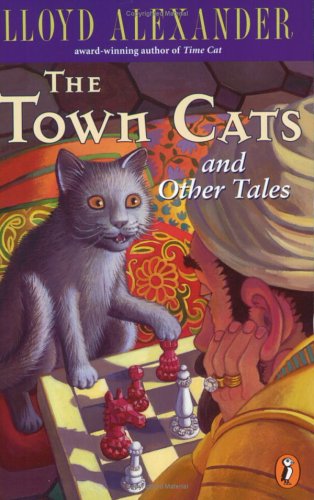
The Town Cats and Other Tales
By Lloyd Alexander
Never take a cat for granted!
Meet Baraka, the cat who play chess more cunningly than any human; Pescato, who becomes mayor for a day and dupes royalty; and other cats who befriend, aid, and outwit their human companions. Brought to life with all of Lloyd Alexander’s trademark wit and style, these felines will make sure that you never look at a cat in quite the same way!
“Brilliant storytelling with an old-world flavor.” —Booklist, starred review
The Town Cats
Valdoro was the smallest town in the farthest corner of the Kingdom of Mondragone. Its people being honest, sensible, and prudent, it boasted no great men of state, scholarship, or military glory. The town council once had given thought to raising a statue of its most distinguished citizen; but, as no accord could be reached on whom this might be, or if indeed there was one, the pedestal in the square stood empty. Valdoro, thus, for many years went happily unknown, unnoticed, and ignored.
One day, however, Ser Basilio, the mayor, received a document from the Directorate of Provincial Affairs. It stated that a Deputy Provincial Commissioner, one Ser Malocchio, would arrive that very afternoon to obtain permanent residence and to supervise all local activities. Henceforth, following the recommendations of the said Deputy Provisional Commissioner, the inhabitants of Valdoro would share the blessings and benefits enjoyed by their fellow subjects throughout the realm.
“He’ll skin us alive with taxes!” cried the cloth merchant, after Basilio had read the pronouncement to all the townsfolk gathered in the square. “Better a visit from the seven year itch!”
“He’ll send all our lads into the army!” wailed the barber’s daughter.
“He’ll set lawyers, clerks, and notaries among us,” the baker cried. “Rather a dozen pickpockets than one of them!”
So, the folk of Valdoro, and Ser Basilio no less than anyone, bemoaned this evil day, sure that never again would they call their lives their own.
Now, there was in Valdoro a certain mackerel-striped cat, Pescato by name. Long-tailed, long-legged, with jaunty tufts of fur at the tips of his ears, this Pescato was known to all as the boldest rascal ever on four paws. Glib enough to wheedle his way into any house he chose, he liked better the streets and alleys. Days, he sunned himself on the pedestal; nights, he prowled the byways or perched on a chimney pot, where he sang melodiously until dawn. He was sleek as an otter, for never in his life had he missed a meal. As the folk of Valdoro kept many cats, most of them related to him one way or another, he could always accept hospitality from his kindred. He preferred, however, living by his wits; to Pescato, a neatly swindled chicken wing tasted sweeter than a whole fowl without the sauce of a clever venture.
That morning, while Ser Basilio and the townsfolk wept and wailed, tore their hair, and gnashed their teeth at the disaster soon to overtake them, Pescato sat on the steps of the town hall, calmly observing these doings. At last, he got up, unfurled his tail, stretched himself, and went to the mayor, saying:
“My dear friend Basilio, how foolish to let a trifle spoil such a pleasant day.”
“Trifle?” cried Basilio, looking ready to fall to the ground from sheer dismay. “You’ll call it a trifle when this Malocchio sets about his poking and prying? Ah, misery of miseries! I can feel those blessings and benefits already, like a hot mustard plaster on my back!”
“Every cat’s a kingdom in himself,” replied Pescato, “and we rule ourselves better than anyone can rule for us. Alas, the same can’t be said for you human creatures.”
“Do you think you’ll escape?” retorted Basilio. “No, no, my fine fellow. You’ll be pinched and squeezed along with the rest of us; and so, too, your kittens, your nephews, nieces, and cousins, and every cat in Valdoro. Will you have table scraps when we can’t afford crust or crumb on our tables? If it’s to be lean pickings for us, then for you no pickings at all.”
“A cat can always make a living in the world,” replied Pescato. “However, as you tell it, I recognize certain inconveniences.” Then, after a few moments of thought, Pescato added:
“Come, cheer up. This is a simple matter, easily set right.”
“So you say,” returned Basilio, casting a doubting eye on Pescato, since the mayor had more than once been on the wrong end of the cat’s enterprises. As he listened to Pescato’s plan, he frowned, shook his head, and declared this would be an impossible endeavor. He soon realized, however, there was no hope otherwise; and admitted the cat’s scheme to be better than his own, which was none whatever. So, at last he agreed that all should be done according to Pescato’s instruction.
“Very well,” said Pescato. “Now, Basilio, fetch me your sash, your ermine cloak and cap, and your chain of office.”
The mayor did as the cat required of him, being assured by Pescato that all this regalia would be returned before the day ended.
“Believe me,” Pescato said, “I have no desire to be mayor a moment longer than need be. Therefore, the sooner we get about our business, the sooner you shall be once again in office.”
So saying, Pescato wrapped the sash around his middle, hung the chain from his neck, and draped the cloak over his shoulders. Thus garbed, and leaving Basilio to certain other duties, Pescato cocked the hat on his head and set off for the bridge he knew Ser Malocchio would be obliged to cross.
There he patiently waited until he glimpsed four horses drawing a gilded coach. As the vehicle clattered over the bridge, Pescato stepped forward and raised a paw. As the coachman, astonished at the sight, hastily pulled up, the occupant, who was none other than Ser Malocchio himself, thrust, his bewigged head out the window and stared in both amazement and indignation.
“What mockery is this?” he cried. Ser Malocchio was a lean-faced, lantern-jawed fellow with a high-ridged nose and a mouth that snapped open and shut like a cash box. His cheeks turned as crimson as the jacket of his uniform, and he shook his fist at Pescato:
“A cat! Tricked out in robes and chains! An insult! A damnable impertinence! Out of my way, beast. We shall soon see who put you up to this. Make sport of a royal officer? That will prove a costly game.”
In spite of this outburst, Pescato doffed his hat, swept a deep and graceful bow, and courteously replied:
“Excellency, allow me humbly to assure you: Things are not as you might suppose. Mock you? On the contrary, I am here in my official capacity to welcome you to Valdoro, and to convey the most respectful greetings of my townspeople.”
“A cat, mayor of a town?” returned Malocchio, still scowling, but a little softened, nevertheless, by Pescato’s deference. “You have strange customs in this part of the country.”
“Your Honor,” answered Pescato, “let me only say again: All is not what it may seem, as I shall presently explain to you. Meantime, forgive me if I am unable to express fully the sensations that stir my heart at your arrival, and the knowledge that our modest village has been deemed worthy of your attention. I could not begin to describe our feelings at the prospect of all the blessings and benefits you must have in store for us; indeed, they are truly unspeakable.”
“Intelligent creature!” exclaimed Malocchio, more and more kindly disposed toward Pescato. Never before had his presence offered the occasion for such agreeable words, and he was delighted to accept such a welcome even from a cat. “Small wonder you are mayor of this town; for I perceive in you rare qualities of statesmanship, and a keen appreciation of the nature of civic administration.”
“May I say in all modesty,” answered Pescato, “no one appreciates it more than I.”
“My dear sir,” cried Malocchio, “what pleasure it is to hear that. Worthy colleague, do me the honor of joining me in my coach.”
“Gladly, Your Worshipful Excellence,” said Pescato, climbing in beside him and ordering the coachman to drive in the direction of the town hall. “I am eager and impatient to learn of your plans for Valdoro, and trust you will reveal them to me without delay. In addition, I have certain suggestions of my own which I earnestly hope you will allow me to offer you.”
“Initiative on the part of His Majesty’s subjects is always highly esteemed,” replied Malocchio, “depending, of course, on the degree to which it enhances His Majesty’s treasury.”
“And perhaps your own, as well?” said Pescato, with a wink. “For it seems to me, worthy Ser Malocchio, that your efforts on behalf of our town should be generously, though discreetly, compensated.”
“How clearly statesmen understand each other,” replied Malocchio, grinning with all his teeth. “It gratifies me to anticipate that we shall conjoin to our mutual advantage.”
“Like two rogues at a town fair,” said Pescato, adding quickly, “an old country expression we use in this corner of the world. Now, to the business at hand. First, I suggest and beseech you to consider establishing a garrison of militia, constabulary, and watchmen. Naturally, for this luxury, our citizens would be overjoyed to pay their wages —through your good offices, of course, leaving the matter of disbursement entirely in your hands.”
“Exactly the manner in which it should be done,” returned Malocchio. “Nothing is more efficacious and economical, and saves burdensome record-keeping.”
“You should also know,” Pescato went on, “that I am hardly able to restrain the men of our town, especially the lame, the halt, and the blind, from their eagerness not to serve in one of the royal regiments. So I suggest that their heroic impulses be expressed through payment of a fee; and, so that all may be just and equitable, the greater their ardor, the larger the sum.”
“What nicety!” cried Malocchio. “What a delicate discernment!”
“Your official residence is not quite prepared,” continued Pescato. “Until it is, I trust you will do me the honor of being my guest. The elegance of my establishment, if I myself dare say so, is no less than you deserve. I assure you I live exactly as I choose; which, in my opinion, is rather well indeed.”
“I sense, dear colleague, that you are one who enjoys the finer things of life,” said Malocchio. “I should not dream of denying you the pleasure of sharing them with me.”
The coach by now had only passed through the outskirts of the town when the coachman suddenly reined up. Vexed at the delay, Malocchio peered out to discover the cause. Stammering, he fell back onto his seat.
In the middle of the street, crouching on all fours, naked as radishes, were Taddeo the barber and Mascolo the butcher. Hissing, spitting, yelling in frenzy, they scuttled back and forth, circling, darting to one side then the other. Next instant, Taddeo shot out his hand and fetched Mascolo a smack on the head; at the same time, Mascolo fetched Taddeo a cuff on the ear. In a trice, barber and butcher went at it hammer and tongs, rolling over the cobbles, grappling, kicking, and miauling at the top of their voices.
“Can I believe my eyes?” cried Malocchio. “Who, sir, are they? Your village idiots?”
“Bobtail and Whitepaw?” replied Pescato. “They mean each other no harm. Those two cats are forever squabbling.”
“Cats?” exclaimed Malocchio. “Cats, you say? Those? But—but you, yourself—”
Pescato shook his head and raised a paw to his lips. “There are, dear friend, certain, shall I say, local conditions. But they are better discussed in private.”
Ser Malocchio had managed to accommodate himself to the notion of dealing with a cat as mayor; but now, having heard two unquestionable men referred to as cats all began turning topsy-turvy in his head. However, before he could ask further, the coach rattled into the square and, at Pescato’s command, drew up in front of the town hall. Pescato beckoned for the bewildered functionary to descend and follow him into the building. And if Ser Malocchio had been taken aback at the sight of the barber and butcher, he gaped all the more at what he presently observed.
For here were some dozen townsfolk scattered throughout the square, perched on barrels, curled on steps, or drowsing on window ledges. In Taddeo’s barber shop, one of Pescato’s cousins, garbed in a white apron, had mounted a high stool and was busy snipping away at the whiskers of one of Pescato’s nephews. In the tailor shop, as one cat measured another for a waistcoat, his assistant, a young orange-and-white cat, unrolled a bolt of cloth, while the human tailor sat cross-legged in a corner, toying with a spool of thread. By the fish market, the fishwife scurried after her three little ones to snatch them up and lick their ears. The greengrocer sped past on all fours, in hot pursuit of a mouse. From the upper windows of the houses, cats and kittens in dust caps and ribbons peered down and waved their paws in welcome.
“What manner of town is this?” babbled Malocchio, following Pescato into the mayor’s chambers. There, Malocchio clapped hands to his head; for, stretched full length on the council table, was Ser Basilio.
“Naughty creature,” Pescato chided, shaking a finger at the mayor. “How often have I told you never to sleep on official papers!”
In response, Basilio rolled over on his back, waving hands and feet in the air. Pescato, clicking his tongue in fond reproach, tickled the mayor under the chin.
“Good fellow,” said Pescato, while Basilio purred and wriggled with delight. “But enough now. Off you go! Behave yourself and you’ll have a fine bit of mackerel for your supper.”
The mayor sprang from the table and loped out the door, while Malocchio’s jaws snapped open and shut as though he were trying vainly to disgorge the words stuck like so many fishbones in his gullet.
“You were about to say that I spoil him?” remarked Pescato. “Yes, no doubt I do. But we must indulge our pets for the sake of the pleasure they give us. Now, a moment of pleasure for ourselves before considering our affairs,” he continued, settling himself in the mayor’s high-backed chair. Taking up a little silver bell, he rang it briskly.
“Ah—ah, Honorable Mayor, colleague—” Malocchio at last was able to stammer, squirming uneasily on the seat Pescato had indicated. “Before all else, you must explain to me—”
That moment, Pescato’s uncle, a stately gray cat with a steward’s key hanging from his neck, came bearing a tray of food and a goblet of wine. Bowing solemnly, he presented this refreshment to Malocchio, who gratefully seized the goblet in trembling hands and immediately gulped down most of its contents.
“You appear a little distracted, my dear friend,” said Pescato. “The result, no doubt, of your long journey. And I quite understand you may have been somewhat unsettled by our particular condition. I assure you, we no longer consider it in the least way disturbing. We go about our business as usual, as you have seen for yourself.”
“As usual?” cried Malocchio. “Great merciful heavens, whatever has befallen you?”
“The situation you may have noticed,” said Pescato, “has come upon us quite recently. I might even say with a degree of suddenness.” Here, Pescato made a show of reluctance to speak further; but, after some hesitation, he continued:
“Needless to say, I rely on your absolute discretion. If so much as a whisper should reach the Provincial Directorate as to the cause of our transformation—you can foresee the consequences. No one would ever set foot in Valdoro, or have anything whatever to do with us.”
“What are you hiding?” burst out Malocchio. “An epidemic? An infestation? Has some horrible disease made your cats look like people, and your people cats?”
“Disease?” replied Pescato. “Indeed, sir, never have I felt better in my life. I confess it was discomfiting at first. But one quickly grows accustomed, and even comes to enjoy it. As you will.”
“I?” shouted Malocchio, springing to his feet. “I? What are you telling me?”
“Yes, you too, since you shall be living among us,” replied Pescato. “After the peculiar occurrence, we made every effort to determine the cause. We concluded it was the wine.”
“Wine?” choked Malocchio, spewing out the last mouthful he had taken, and flinging away the goblet.
“Calm yourself,” said Pescato. “We soon understood it was not our wine, since not all of us drink it. And so we judged it must be the food.”
“Food?” cried Malocchio, sweeping aside the tray of refreshments. “Poison!”
“Be at ease,” Pescato assured him. “Eat your fill. It was not the food, nor the water. We examined both and found no fault with either.”
Malocchio heaved a sigh of relief. But Pescato continued:
“No, none of these things. In the firm opinion of the town physician, the apothecary, and all our learned individuals: beyond any doubt, it is the air.”
“Air?” sputtered Malocchio. “Did you say air?”
“The very air you are breathing at this instant,” said Pescato.
Hearing this, Malocchio gave a shriek of horror, emptied his lungs in a great gust, clapped one hand over his mouth and the other over his nose. Stifling his gasps, terrified to draw so much as another breath, he dashed from the chamber. While his face turned at first red, then lavender, then purple for want of air, he threw himself into the coach, buried his head under the seat cushions, and went galloping out of town, never stopping and scarcely breathing until he reached the capital.
Never again was Valdoro troubled with any Provincial Commissioners. Nor did Ser Malocchio reveal what he had seen, lest his superiors think him altogether out of his wits. Instead, he claimed that a terrible pestilence had stricken the town and not one human being remained. So Valdoro was removed from the maps and blotted from the archives, and a special directive was issued declaring the town had never existed in the first place. Yet, ever after, Ser Malocchio was continually scrutinizing his face in the mirror, fearful that he might at any moment sprout cat’s whiskers or grow fur from his ears.
And so the folk of Valdoro happily resumed their former ways. Pescato was proclaimed Town Cat; and the mayor and the council unanimously voted to raise a bronze figure of him. Pescato, however, declined this honor, seeing no reason to give up his comfortable spot on the pedestal for the sake of a mere statue.