2 апреля — Международный день детской книги.
Начиная с 1967 года по инициативе и решению Международного совета по детской книге (International Board on Books for Young People, IBBY) ежегодно 2 апреля, в день рождения великого сказочника из Дании Ганса Христиана Андерсена (Hans Christian Andersen), весь мир отмечает Международный день детской книги (International Children’s Book Day).
Предлагаем вам три сказки Ганса Христиана Андерсена.
The Princess on the Pea
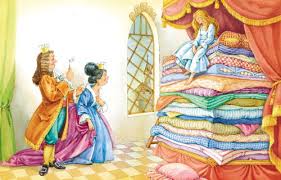
Once there was a Prince who wanted to marry a Princess. Only a real one would do. So he traveled through all the world to find her, and everywhere things went wrong. There were Princesses aplenty, but how was he to know whether they were real Princesses? There was something not quite right about them all. So he came home again and was unhappy, because he did so want to have a real Princess.
One evening a terrible storm blew up. It lightened and thundered and rained. It was really frightful! In the midst of it all came a knocking at the town gate. The old King went to open it.
Who should be standing outside but a Princess, and what a sight she was in all that rain and wind. Water streamed from her hair down her clothes into her shoes, and ran out at the heels. Yet she claimed to be a real Princess.
«We’ll soon find that out,» the old Queen thought to herself. Without saying a word about it she went to the bedchamber, stripped back the bedclothes, and put just one pea in the bottom of the bed. Then she took twenty mattresses and piled them on the pea. Then she took twenty eiderdown feather beds and piled them on the mattresses. Up on top of all these the Princess was to spend the night.
In the morning they asked her, «Did you sleep well?»
» Oh!» said the Princess. «No. I scarcely slept at all. Heaven knows what’s in that bed. I lay on something so hard that I’m black and blue all over. It was simply terrible.»
They could see she was a real Princess and no question about it, now that she had felt one pea all the way through twenty mattresses and twenty more feather beds. Nobody but a Princess could be so delicate. So the Prince made haste to marry her, because he knew he had found a real Princess.
As for the pea, they put it in the museum. There it’s still to be seen, unless somebody has taken it.
There, that’s a true story.
Thumbelina
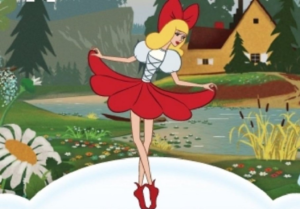
There once was a woman who wanted so very much to have a tiny little child, but she did not know where to find one. So she went to an old witch, and she said:
«I have set my heart upon having a tiny little child. Please could you tell me where I can find one?»
«Why, that’s easily done,» said the witch. «Here’s a grain of barley for you, but it isn’t at all the sort of barley that farmers grow in their fields or that the chickens get to eat. Put it in a flower pot and you’ll see what you shall see.»
«Oh thank you!» the woman said. She gave the witch twelve pennies, and planted the barley seed as soon as she got home. It quickly grew into a fine large flower, which looked very much like a tulip. But the petals were folded tight, as though it were still a bud.
«This is such a pretty flower,» said the woman. She kissed its lovely red and yellow petals, and just as she kissed it the flower gave a loud pop! and flew open. It was a tulip, right enough, but on the green cushion in the middle of it sat a tiny girl. She was dainty and fair to see, but she was no taller than your thumb. So she was called Thumbelina.
A nicely polished walnut shell served as her cradle. Her mattress was made of the blue petals of violets, and a rose petal was pulled up to cover her. That was how she slept at night. In the daytime she played on a table where the woman put a plate surrounded with a wreath of flowers. Their stems lay in the water, on which there floated a large tulip petal. Thumbelina used the petal as a boat, and with a pair of white horsehairs for oars she could row clear across the plate-a charming sight. She could sing, too. Her voice was the softest and sweetest that anyone ever has heard.
One night as she lay in her cradle, a horrible toad hopped in through the window-one of the panes was broken. This big, ugly, slimy toad jumped right down on the table where Thumbelina was asleep under the red rose petal.
«Here’s a perfect wife for my son!» the toad exclaimed. She seized upon the walnut shell in which Thumbelina lay asleep, and hopped off with it, out the window and into the garden. A big broad stream ran through it, with a muddy marsh along its banks, and here the toad lived with her son. Ugh! he was just like his mother, slimy and horrible. «Co-ax, co-ax, brek-ek-eke-kex,» was all that he could say when he saw the graceful little girl in the walnut shell.
«Don’t speak so loud, or you will wake her up,» the old toad told him. «She might get away from us yet, for she is as light as a puff of swan’s-down. We must put her on one of the broad water lily leaves out in the stream. She is so small and light that it will be just like an island to her, and she can’t run away from us while we are making our best room under the mud ready for you two to live in.»
Many water lilies with broad green leaves grew in the stream, and it looked as if they were floating on the surface. The leaf which lay furthest from the bank was the largest of them all, and it was to this leaf that the old toad swam with the walnut shell which held Thumbelina.
The poor little thing woke up early next morning, and when she saw where she was she began to cry bitterly. There was water all around the big green leaf and there was no way at all for her to reach the shore. The old toad sat in the mud, decorating a room with green rushes and yellow water lilies, to have it looking its best for her new daughter-in-law. Then she and her ugly son swam out to the leaf on which Thumbelina was standing. They came for her pretty little bed, which they wanted to carry to the bridal chamber before they took her there.
The old toad curtsied deep in the water before her, and said:
«Meet my son. He is to be your husband, and you will share a delightful home in the mud.»
«Co-ax, co-ax, brek-ek-eke-kex,» was all that her son could say.
Then they took the pretty little bed and swam away with it. Left all alone on the green leaf, Thumbelina sat down and cried. She did not want to live in the slimy toad’s house, and she didn’t want to have the toad’s horrible son for her husband. The little fishes who swam in the water beneath her had seen the toad and heard what she had said. So up popped their heads to have a look at the little girl. No sooner had they seen her than they felt very sorry that anyone so pretty should have to go down to live with that hideous toad. No, that should never be! They gathered around the green stem which held the leaf where she was, and gnawed it in two with their teeth. Away went the leaf down the stream, and away went Thumbelina, far away where the toad could not catch her.
Thumbelina sailed past many a place, and when the little birds in the bushes saw her they sang, «What a darling little girl.» The leaf drifted further and further away with her, and so it was that Thumbelina became a traveler.
A lovely white butterfly kept fluttering around her, and at last alighted on the leaf, because he admired Thumbelina. She was a happy little girl again, now that the toad could not catch her. It was all very lovely as she floated along, and where the sun struck the water it looked like shining gold. Thumbelina undid her sash, tied one end of it to the butterfly, and made the other end fast to the leaf. It went much faster now, and Thumbelina went much faster too, for of course she was standing on it.
Just then, a big May-bug flew by and caught sight of her. Immediately he fastened his claws around her slender waist and flew with her up into a tree. Away went the green leaf down the stream, and away went the butterfly with it, for he was tied to the leaf and could not get loose.
My goodness! How frightened little Thumbelina was when the May-bug carried her up in the tree. But she was even more sorry for the nice white butterfly she had fastened to the leaf, because if he couldn’t free himself he would have to starve to death. But the May-bug wasn’t one to care about that. He sat her down on the largest green leaf of the tree, fed her honey from the flowers, and told her how pretty she was, considering that she didn’t look the least like a May-bug. After a while, all the other May-bugs who lived in the tree came to pay them a call. As they stared at Thumbelina, the lady May-bugs threw up their feelers and said:
«Why, she has only two legs-what a miserable sight!»
«She hasn’t any feelers,» one cried.
«She is pinched in at the waist-how shameful! She looks like a human being-how ugly she is!» said all of the female May-bugs.
Yet Thumbelina was as pretty as ever. Even the May-bug who had flown away with her knew that, but as every last one of them kept calling her ugly, he at length came to agree with them and would have nothing to do with her-she could go wherever she chose. They flew down out of the tree with her and left her on a daisy, where she sat and cried because she was so ugly that the May-bugs wouldn’t have anything to do with her.
Nevertheless, she was the loveliest little girl you can imagine, and as frail and fine as the petal of a rose.
All summer long, poor Thumbelina lived all alone in the woods. She wove herself a hammock of grass, and hung it under a big burdock leaf to keep off the rain. She took honey from the flowers for food, and drank the dew which she found on the leaves every morning. In this way the summer and fall went by. Then came the winter, the long, cold winter. All the birds who had sung so sweetly for her flew away. The trees and the flowers withered. The big burdock leaf under which she had lived shriveled up until nothing was left of it but a dry, yellow stalk. She was terribly cold, for her clothes had worn threadbare and she herself was so slender and frail. Poor Thumbelina, she would freeze to death! Snow began to fall, and every time a snowflake struck her it was as if she had been hit by a whole shovelful, for we are quite tall while she measured only an inch. She wrapped a withered leaf about her, but there was no warmth in it. She shivered with cold.
Near the edge of the woods where she now had arrived, was a large grain field, but the grain had been harvested long ago. Only the dry, bare stubble stuck out of the frozen ground. It was just as if she were lost in a vast forest, and oh how she shivered with cold! Then she came to the door of a field mouse, who had a little hole amidst the stubble. There this mouse lived, warm and cozy, with a whole store-room of grain, and a magnificent kitchen and pantry. Poor Thumbelina stood at the door, just like a beggar child, and pled for a little bit of barley, because she hadn’t had anything to eat for two days past.
«Why, you poor little thing,» said the field mouse, who turned out to be a kind-hearted old creature. «You must come into my warm room and share my dinner.» She took such a fancy to Thumbelina that she said, «If you care to, you may stay with me all winter, but you must keep my room tidy, and tell me stories, for I am very fond of them.» Thumbelina did as the kind old field mouse asked and she had a very good time of it.
«Soon we shall have a visitor,» the field mouse said. «Once every week my neighbor comes to see me, and he is even better off than I am. His rooms are large, and he wears such a beautiful black velvet coat. If you could only get him for a husband you would be well taken care of, but he can’t see anything. You must tell him the very best stories you know.»
Thumbelina did not like this suggestion. She would not even consider the neighbor, because he was a mole. He paid them a visit in his black velvet coat. The field mouse talked about how wealthy and wise he was, and how his home was more than twenty times larger than hers. But for all of his knowledge he cared nothing at all for the sun and the flowers. He had nothing good to say for them, and had never laid eyes on them. As
Thumbelina had to sing for him, she sang, «May-bug, May-bug, fly away home,» and «The Monk goes afield.» The mole fell in love with her sweet voice, but he didn’t say anything about it yet, for he was a most discreet fellow.
He had just dug a long tunnel through the ground from his house to theirs, and the field mouse and Thumbelina were invited to use it whenever they pleased, though he warned them not to be alarmed by the dead bird which lay in this passage. It was a complete bird, with feather and beak. It must have died quite recently, when winter set in, and it was buried right in the middle of the tunnel.
The mole took in his mouth a torch of decayed wood. In the darkness it glimmered like fire. He went ahead of them to light the way through the long, dark passage. When they came to where the dead bird lay, the mole put his broad nose to the ceiling and made a large hole through which daylight could fall. In the middle of the floor lay a dead swallow, with his lovely wings folded at his sides and his head tucked under his feathers. The poor bird must certainly have died of the cold. Thumbelina felt so sorry for him. She loved all the little birds who had sung and sweetly twittered to her all through the summer. But the mole gave the body a kick with his short stumps, and said, «Now he won’t be chirping any more. What a wretched thing it is to be born a little bird. Thank goodness none of my children can be a bird, who has nothing but his ‘chirp, chirp’, and must starve to death when winter comes along.»
«Yes, you are so right, you sensible man,» the field mouse agreed. «What good is all his chirp-chirping to a bird in the winter time, when he starves and freezes? But that’s considered very grand, I imagine.»
Thumbelina kept silent, but when the others turned their back on the bird she bent over, smoothed aside the feathers that hid the bird’s head, and kissed his closed eyes.
«Maybe it was he who sang so sweetly to me in the summertime,» she thought to herself. «What pleasure he gave me, the dear, pretty bird.»
The mole closed up the hole that let in the daylight, and then he took the ladies home. That night Thumbelina could not sleep a wink, so she got up and wove a fine large coverlet out of hay. She took it to the dead bird and spread it over him, so that he would lie warm in the cold earth. She tucked him in with some soft thistledown that she had found in the field mouse’s room.
«Good-by, you pretty little bird,» she said. «Good-by, and thank you for your sweet songs last summer, when the trees were all green and the sun shone so warmly upon us.» She laid her head on his breast, and it startled her to feel a soft thump, as if something were beating inside. This was the bird’s heart. He was not dead- he was only numb with cold, and now that he had been warmed he came to life again.
In the fall, all swallows fly off to warm countries, but if one of them starts too late he gets so cold that he drops down as if he were dead, and lies where he fell. And then the cold snow covers him.
Thumbelina was so frightened that she trembled, for the bird was so big, so enormous compared to her own inch of height. But she mustered her courage, tucked the cotton wool down closer around the poor bird, brought the mint leaf that covered her own bed, and spread it over the bird’s head.
The following night she tiptoed out to him again. He was alive now, but so weak that he could barely open his eyes for a moment to look at Thumbelina, who stood beside him with the piece of touchwood that was her only lantern.
«Thank you, pretty little child,» the sick swallow said. «I have been wonderfully warmed. Soon I shall get strong once more, and be able to fly again in the warm sunshine.»
«Oh,» she said, «It’s cold outside, it’s snowing, and freezing. You just stay in your warm bed and I’ll nurse you.»
Then she brought him some water in the petal of a flower. The swallow drank, and told her how he had hurt one of his wings in a thorn bush, and for that reason couldn’t fly as fast as the other swallows when they flew far, far away to the warm countries. Finally he had dropped to the ground. That was all he remembered, and he had no idea how he came to be where she found him.
The swallow stayed there all through the winter, and Thumbelina was kind to him and tended him with loving care. She didn’t say anything about this to the field mouse or to the mole, because they did not like the poor unfortunate swallow.
As soon as spring came and the sun warmed the earth, the swallow told Thumbelina it was time to say good-by. She reopened the hole that the mole had made in the ceiling, and the sun shone in splendor upon them. The swallow asked Thumbelina to go with him. She could sit on his back as they flew away through the green woods. But Thumbelina knew that it would make the old field mouse feel badly if she left like that, so she said:
«No, I cannot go.»
«Fare you well, fare you well, my good and pretty girl,» said the swallow, as he flew into the sunshine. Tears came into Thumbelina’s eyes as she watched him go, for she was so fond of the poor swallow.
«Chirp, chirp!» sang the bird, at he flew into the green woods.
Thumbelina felt very downcast. She was not permitted to go out in the warm sunshine. Moreover, the grain that was sown in the field above the field mouse’s house grew so tall that, to a poor little girl who was only an inch high, it was like a dense forest.
«You must work on your trousseau this summer,» the field mouse said, for their neighbor, that loathsome mole in his black velvet coat, had proposed to her. «You must have both woolens and linens, both bedding and wardrobe, when you become the mole’s wife.»
Thumbelina had to turn the spindle, and the field mouse hired four spiders to spin and weave for her day and night. The mole came to call every evening, and his favorite remark was that the sun, which now baked the earth as hard as a rock, would not be nearly so hot when summer was over. Yes, as soon as summer was past he would be marrying Thumbelina. But she was not at all happy about it, because she didn’t like the tedious mole the least bit. Every morning at sunrise and every evening at sunset, she would steal out the door. When the breeze blew the ears of grain apart she could catch glimpses of the blue sky. She could dream about how bright and fair it was out of doors, and how she wished she would see her dear swallow again. But he did not come back, for doubtless he was far away, flying about in the lovely green woods.
When fall arrived, Thumbelina’s whole trousseau was ready.
«Your wedding day is four weeks off,» the field mouse told her. But Thumbelina cried and declared that she would not have the tedious mole for a husband.
«Fiddlesticks,» said the field mouse. «Don’t you be obstinate, or I’ll bite you with my white teeth. Why, you’re getting a superb husband. The queen herself hasn’t a black velvet coat as fine as his. Both his kitchen and his cellar are well supplied. You ought to thank goodness that you are getting him.»
Then came the wedding day. The mole had come to take Thumbelina home with him, where she would have to live deep underground and never go out in the warm sunshine again, because he disliked it so. The poor little girl felt very sad that she had to say good-by to the glorious sun, which the field mouse had at least let her look out at through the doorway.
«Farewell, bright sun!» she said. With her arm stretched toward it she walked a little way from the field mouse’s home. The grain had been harvested, and only the dry stubble was left in the field. «Farewell. farewell!» she cried again, and flung her little arms around a small red flower that was still in bloom. «If you see my dear swallow, please give him my love.»
«Chirp, chirp! Chirp, chirp!» She suddenly heard a twittering over her head. She looked up and there was the swallow, just passing by. He was so glad to see Thumbelina although, when she told him how she hated to marry the mole and live deep underground where the sun never shone, she could not hold back her tears.
«Now that the cold winter is coming,» the swallow told her, «I shall fly far, far away to the warm countries. Won’t you come along with me? You can ride on my back. Just tie yourself on with your sash, and away we’ll fly, far from the ugly mole and his dark hole-far, far away, over the mountains to the warm countries where the sun shines so much fairer than here, to where it is always summer and there are always flowers. Please fly away with me, dear little Thumbelina, you who saved my life when I lay frozen in a dark hole in the earth.»
«Yes, I will go with you!» said Thumbelina. She sat on his back, put her feet on his outstretched wings, and fastened her sash to one of his strongest feathers. Then the swallow soared into the air over forests and over lakes, high up over the great mountains that are always capped with snow. When Thumbelina felt cold in the chill air, she crept under the bird’s warm feathers, with only her little head stuck out to watch all the wonderful sights below.
At length they came to the warm countries. There the sun shone far more brightly than it ever does here, and the sky seemed twice as high. Along the ditches and hedgerows grew marvelous green and blue grapes. Lemons and oranges hung in the woods. The air smelled sweetly of myrtle and thyme. By the wayside, the loveliest children ran hither and thither, playing with the brightly colored butterflies.
But the swallow flew on still farther, and it became more and more beautiful. Under magnificent green trees, on the shore of a blue lake there stood an ancient palace of dazzling white marble. The lofty pillars were wreathed with vines, and at the top of them many swallows had made their nests. One nest belonged to the swallow who carried Thumbelina.
«This is my home,» the swallow told her. «If you will choose one of those glorious flowers in bloom down below, I shall place you in it, and you will have all that your heart desires.»
«That will be lovely,» she cried, and clapped her tiny hands.
A great white marble pillar had fallen to the ground, where it lay in three broken pieces. Between these pieces grew the loveliest large white flowers. The swallow flew down with Thumbelina and put her on one of the large petals. How surprised she was to find in the center of the flower a little man, as shining and transparent as if he had been made of glass. On his head was the daintiest of little gold crowns, on his shoulders were the brightest shining wings, and he was not a bit bigger than Thumbelina. He was the spirit of the flower. In every flower there lived a small man or woman just like him, but he was the king over all of them.
«Oh, isn’t he handsome?» Thumbelina said softly to the swallow. The king was somewhat afraid of the swallow, which seemed a very giant of a bird to anyone as small as he. But when he saw Thumbelina he rejoiced, for she was the prettiest little girl he had ever laid eyes on. So he took off his golden crown and put it on her head. He asked if he might know her name, and he asked her to be his wife, which would make her queen over all the flowers. Here indeed was a different sort of husband from the toad’s son and the mole with his black velvet coat. So she said «Yes» to this charming king. From all the flowers trooped little ladies and gentlemen delightful to behold. Every one of them brought Thumbelina a present, but the best gift of all was a pair of wings that had belonged to a large silver fly. When these were made fast to her back, she too could flit from flower to flower. Everyone rejoiced, as the swallow perched above them in his nest and sang his very best songs for them. He was sad though, deep down in his heart, for he liked Thumbelina so much that he wanted never to part with her.
«You shall no longer be called Thumbelina,» the flower spirit told her. » That name is too ugly for anyone as pretty as you are. We shall call you Maia.»
«Good-by, good-by,» said the swallow. He flew away again from the warm countries, back to far-away Denmark, where he had a little nest over the window of the man who can tell you fairy tales. To him the bird sang, «Chirp, chirp! Chirp, chirp!» and that’s how we heard the whole story.
The Steadfast Tin Soldier
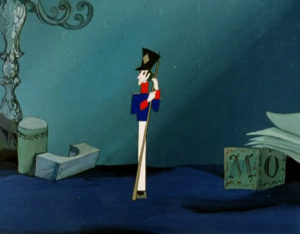
There were once five-and-twenty tin soldiers. They were all brothers, born of the same old tin spoon. They shouldered their muskets and looked straight ahead of them, splendid in their uniforms, all red and blue.
The very first thing in the world that they heard was, «Tin soldiers!» A small boy shouted it and clapped his hands as the lid was lifted off their box on his birthday. He immediately set them up on the table.
All the soldiers looked exactly alike except one. He looked a little different as he had been cast last of all. The tin was short, so he had only one leg. But there he stood, as steady on one leg as any of the other soldiers on their two. But just you see, he’ll be the remarkable one.
On the table with the soldiers were many other playthings, and one that no eye could miss was a marvelous castle of cardboard. It had little windows through which you could look right inside it. And in front of the castle were miniature trees around a little mirror supposed to represent a lake. The wax swans that swam on its surface were reflected in the mirror. All this was very pretty but prettiest of all was the little lady who stood in the open doorway of the castle. Though she was a paper doll, she wore a dress of the fluffiest gauze. A tiny blue ribbon went over her shoulder for a scarf, and in the middle of it shone a spangle that was as big as her face. The little lady held out both her arms, as a ballet dancer does, and one leg was lifted so high behind her that the tin soldier couldn’t see it at all, and he supposed she must have only one leg, as he did.
«That would be a wife for me,» he thought. «But maybe she’s too grand. She lives in a castle. I have only a box, with four-and-twenty roommates to share it. That’s no place for her. But I must try to make her acquaintance.» Still as stiff as when he stood at attention, he lay down on the table behind a snuffbox, where he could admire the dainty little dancer who kept standing on one leg without ever losing her balance.
When the evening came the other tin soldiers were put away in their box, and the people of the house went to bed. Now the toys began to play among themselves at visits, and battles, and at giving balls. The tin soldiers rattled about in their box, for they wanted to play too, but they could not get the lid open. The nutcracker turned somersaults, and the slate pencil squeaked out jokes on the slate. The toys made such a noise that they woke up the canary bird, who made them a speech, all in verse. The only two who stayed still were the tin soldier and the little dancer. Without ever swerving from the tip of one toe, she held out her arms to him, and the tin soldier was just as steadfast on his one leg. Not once did he take his eyes off her.
Then the clock struck twelve and — clack! — up popped the lid of the snuffbox. But there was no snuff in it, no-out bounced a little black bogey, a jack-in-the-box.
«Tin soldier,» he said. «Will you please keep your eyes to yourself?» The tin soldier pretended not to hear.
The bogey said, «Just you wait till tomorrow.»
But when morning came, and the children got up, the soldier was set on the window ledge. And whether the bogey did it, or there was a gust of wind, all of a sudden the window flew open and the soldier pitched out headlong from the third floor. He fell at breathtaking speed and landed cap first, with his bayonet buried between the paving stones and his one leg stuck straight in the air. The housemaid and the little boy ran down to look for him and, though they nearly stepped on the tin soldier, they walked right past without seeing him. If the soldier had called, «Here I am!» they would surely have found him, but he thought it contemptible to raise an uproar while he was wearing his uniform.
Soon it began to rain. The drops fell faster and faster, until they came down by the bucketful. As soon as the rain let up, along came two young rapscallions.
«Hi, look!» one of them said, «there’s a tin soldier. Let’s send him sailing.»
They made a boat out of newspaper, put the tin soldier in the middle of it, and away he went down the gutter with the two young rapscallions running beside him and clapping their hands. High heavens! How the waves splashed, and how fast the water ran down the gutter. Don’t forget that it had just been raining by the bucketful. The paper boat pitched, and tossed, and sometimes it whirled about so rapidly that it made the soldier’s head spin. But he stood as steady as ever. Never once flinching, he kept his eyes front, and carried his gun shoulder-high. Suddenly the boat rushed under a long plank where the gutter was boarded over. It was as dark as the soldier’s own box.
«Where can I be going?» the soldier wondered. «This must be that black bogey’s revenge. Ah! if only I had the little lady with me, it could be twice as dark here for all that I would care.»
Out popped a great water rat who lived under the gutter plank.
«Have you a passport?» said the rat. «Hand it over.»
The soldier kept quiet and held his musket tighter. On rushed the boat, and the rat came right after it, gnashing his teeth as he called to the sticks and straws:
«Halt him! Stop him! He didn’t pay his toll. He hasn’t shown his passport. «But the current ran stronger and stronger. The soldier could see daylight ahead where the board ended, but he also heard a roar that would frighten the bravest of us. Hold on! Right at the end of that gutter plank the water poured into the great canal. It was as dangerous to him as a waterfall would be to us.
He was so near it he could not possibly stop. The boat plunged into the whirlpool. The poor tin soldier stood as staunch as he could, and no one can say that he so much as blinked an eye. Thrice and again the boat spun around. It filled to the top — and was bound to sink. The water was up to his neck and still the boat went down, deeper, deeper, deeper, and the paper got soft and limp. Then the water rushed over his head. He thought of the pretty little dancer whom he’d never see again, and in his ears rang an old, old song:
«Farewell, farewell, O warrior brave,
Nobody can from Death thee save.»
And now the paper boat broke beneath him, and the soldier sank right through. And just at that moment he was swallowed by a most enormous fish.
My! how dark it was inside that fish. It was darker than under the gutter-plank and it was so cramped, but the tin soldier still was staunch. He lay there full length, soldier fashion, with musket to shoulder.
Then the fish flopped and floundered in a most unaccountable way. Finally it was perfectly still, and after a while something struck through him like a flash of lightning. The tin soldier saw daylight again, and he heard a voice say, «The Tin Soldier!» The fish had been caught, carried to market, bought, and brought to a kitchen where the cook cut him open with her big knife.
She picked the soldier up bodily between her two fingers, and carried him off upstairs. Everyone wanted to see this remarkable traveler who had traveled about in a fish’s stomach, but the tin soldier took no pride in it. They put him on the table and-lo and behold, what curious things can happen in this world-there he was, back in the same room as before. He saw the same children, the same toys were on the table, and there was the same fine castle with the pretty little dancer. She still balanced on one leg, with the other raised high. She too was steadfast. That touched the soldier so deeply that he would have cried tin tears, only soldiers never cry. He looked at her, and she looked at him, and never a word was said. Just as things were going so nicely for them, one of the little boys snatched up the tin soldier and threw him into the stove. He did it for no reason at all. That black bogey in the snuffbox must have put him up to it.
The tin soldier stood there dressed in flames. He felt a terrible heat, but whether it came from the flames or from his love he didn’t know. He’d lost his splendid colors, maybe from his hard journey, maybe from grief, nobody can say.
He looked at the little lady, and she looked at him, and he felt himself melting. But still he stood steadfast, with his musket held trim on his shoulder.
Then the door blew open. A puff of wind struck the dancer. She flew like a sylph, straight into the fire with the soldier, blazed up in a flash, and was gone. The tin soldier melted, all in a lump. The next day, when a servant took up the ashes she found him in the shape of a little tin heart. But of the pretty dancer nothing was left except her spangle, and it was burned as black as a coal.